


On behalf of the Stanford Economic Review Editorial Board, we are honored to present the thirteenth volume of Stanford University’s undergraduate economics journal. During the 2024–2025 academic year, we have focused on fostering a stronger connection between the undergraduate and graduate economics communities at Stanford. Most notably, in an effort to lower barriers to entry… Continue reading Our 2025 Issue

COMMENTARY: Cybersecurity as a Public Good: The Market Failure Behind America’s Digital Defense
Navtej Singh Kathuria, University of Illinois at Urbana-Champaign -- The United States is engaged in deep and fierce battles over education, healthcare, immigration and international engagement, yet both the Biden and Trump administrations have embraced an undeniable truth: cybersecurity tantamount to national security.

COMMENTARY: Trump’s Economic Thinking Misunderstands How Modern Economies Actually Work
Ankur Singh, O.P Jindal Global University -- As fears of a U.S. recession grow, policymakers continue to frame economic policies through a misleading lens that conflates government debt with household debt and views trade deficits as signs of economic weakness. This flawed narrative has contributed to damaging fiscal austerity, misguided protectionism, and heightened economic uncertainty.
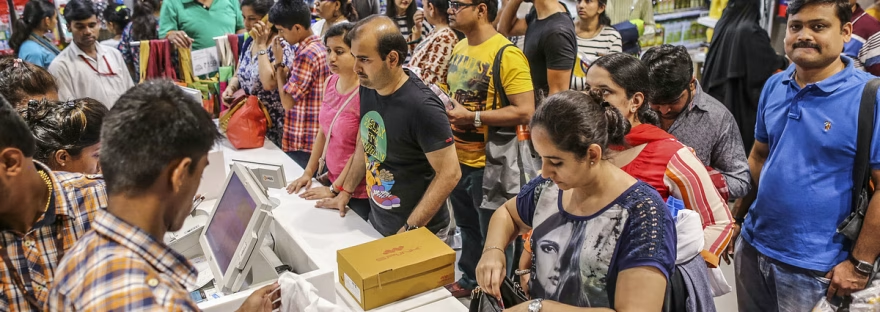
COMMENTARY: India’s Growing Debt Trap: How Rising Credit Card Defaults Reflect a Deeper Crisis
Aditi Desai, University of Mumbai -- While credit expansion and increased consumption reflect a growing economy in India, unchecked household debt accumulation can pose long-term risks. Addressing these challenges through a combination of regulatory oversight, financial education, and responsible lending practices is essential to ensure sustainable financial well-being for Indian households.

COMMENTARY: Economic Statecraft in a Fractured World
Colin Chow, National University of Singapore -- For today's major powers, openness has shifted from a stabilizing force to a perceived strategic vulnerability. Technologies such as semiconductors, artificial intelligence, and green energy have increasingly become geostrategic assets, embedding economic policy firmly within the calculus of national security. From Washington to Beijing, industrial policy is now crafted not primarily for economic growth or efficiency, but to secure technological primacy, mitigate strategic dependencies, and safeguard core national interests.

COMMENTARY: Another BRIC in the Wall
Nirvaan Pandit, Stanford University -- As Global South club “BRICS” expands, it teeters between potential and paralysis—poised to reshape the global order in a time of volatility, yet just as likely to fade into the background of failed coalitions. For India—caught between Western partnership and Southern solidarity—the dilemma lies in choosing between them.

COMMENTARY: Is Banking Regulation a Vicious Cycle?
Araha Uday, Stanford University -- Supervision and regulation as we know emerged following the Great Recession when policymakers vowed to prevent what took place then–billions of dollars in bailouts for the biggest banks—from happening again. Although the majority of bailed-out banks eventually repaid their loans (leading to the federal government profiting $109 billion), some still have outstanding balances. Still, a few missed payments are a small price to keep banks afloat; at least a chance of future repayment remains. A complete bank failure, on the other hand, would mean no repayments at all, highlighting the high stakes in maintaining a stable banking system.

COMMENTARY: AI in Agriculture: Transforming Food Security in Sub-Saharan Africa
Paul Squatrito, University of Oregon -- Sub-Saharan Africa stands at a pivotal juncture. The region’s population is projected to double by 2050, exceeding 2.5 billion people, placing immense pressure on food systems already struggling to meet demand. Compounding this challenge are climate-induced disruptions, post-harvest inefficiencies, and limited access to modern agricultural inputs. With over 280 million people facing food insecurity, technological innovation is not merely an option but a necessity. Artificial intelligence (AI) has emerged as a potent force, capable of addressing systemic inefficiencies, predicting risks, and optimizing agricultural productivity. Yet, the integration of AI into agriculture is fraught with challenges, including technological inequities and the potential displacement of rural labor.

COMMENTARY: Who Pays for Peace? The Economics of United Nations Funding and American Contributions
Kyle Feinstein, Stanford University -- The world’s eyes are on the United Nations as President Trump signed an executive order to withdraw the United States from the United Nations Human Rights Council (UNHRC). President Trump’s act will halt American funding for the UNHRC and the UN Relief and Works Agency (UNRWA), a support organization for Palestinian refugees. This withdrawal is a response to perceived anti-Israel bias and concern over the inclusion of member states with questionable human rights records.