Navtej Singh Kathuria, University of Illinois at Urbana-Champaign -- The United States is engaged in deep and fierce battles over education, healthcare, immigration and international engagement, yet both the Biden and Trump administrations have embraced an undeniable truth: cybersecurity tantamount to national security.
Tag: International
COMMENTARY: Trump’s Economic Thinking Misunderstands How Modern Economies Actually Work
Ankur Singh, O.P Jindal Global University -- As fears of a U.S. recession grow, policymakers continue to frame economic policies through a misleading lens that conflates government debt with household debt and views trade deficits as signs of economic weakness. This flawed narrative has contributed to damaging fiscal austerity, misguided protectionism, and heightened economic uncertainty.
COMMENTARY: India’s Growing Debt Trap: How Rising Credit Card Defaults Reflect a Deeper Crisis
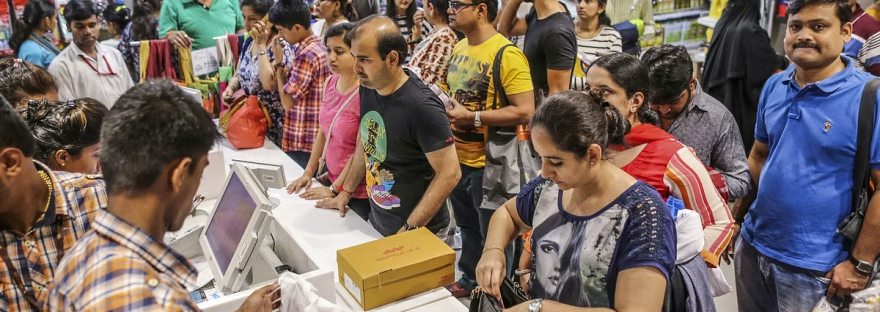
Aditi Desai, University of Mumbai -- While credit expansion and increased consumption reflect a growing economy in India, unchecked household debt accumulation can pose long-term risks. Addressing these challenges through a combination of regulatory oversight, financial education, and responsible lending practices is essential to ensure sustainable financial well-being for Indian households.
COMMENTARY: Economic Statecraft in a Fractured World
Colin Chow, National University of Singapore -- For today's major powers, openness has shifted from a stabilizing force to a perceived strategic vulnerability. Technologies such as semiconductors, artificial intelligence, and green energy have increasingly become geostrategic assets, embedding economic policy firmly within the calculus of national security. From Washington to Beijing, industrial policy is now crafted not primarily for economic growth or efficiency, but to secure technological primacy, mitigate strategic dependencies, and safeguard core national interests.
COMMENTARY: Another BRIC in the Wall
Nirvaan Pandit, Stanford University -- As Global South club “BRICS” expands, it teeters between potential and paralysis—poised to reshape the global order in a time of volatility, yet just as likely to fade into the background of failed coalitions. For India—caught between Western partnership and Southern solidarity—the dilemma lies in choosing between them.
COMMENTARY: Who Pays for Peace? The Economics of United Nations Funding and American Contributions
Kyle Feinstein, Stanford University -- The world’s eyes are on the United Nations as President Trump signed an executive order to withdraw the United States from the United Nations Human Rights Council (UNHRC). President Trump’s act will halt American funding for the UNHRC and the UN Relief and Works Agency (UNRWA), a support organization for Palestinian refugees. This withdrawal is a response to perceived anti-Israel bias and concern over the inclusion of member states with questionable human rights records.
COMMENTARY: Power Shifts as Powers Shift: Energy Realignment After Russia’s Invasion
Eliana Svilik, Stanford University -- Global energy markets have transformed since Russia’s full-scale invasion of Ukraine shifted key resource flows, creating new winners and losers. Prior to Russia’s invasion of Ukraine, the former was the world’s second largest producer of natural gas and third largest producer of crude oil. EU member states relied on this supply for the majority of its oil and gas as part of a developed, seemingly mutual partnership. As the third anniversary of Russia’s invasion nears, changes in energy supply chains demonstrate that the U.S. and EU have largely won the concurrent energy war.
COMMENTARY: The World Trade Organization Is Dying—And U.S. Consumers Will Pay the Price
Amy Cao, Stanford University -- On January 20, President Trump returned to office. In the month since, the President has levied 25% tariffs against Canada and 10% tariffs against China. After President Trump’s first term already dismantled the World Trade Organization (WTO) and associated guardrails, the effects this time could be catastrophic beyond imagination.
COMMENTARY: Performance, Islamization, and Trust: Pakistan’s Evolving Banking Sector
Fasih Zulfiqar, IBA Karachi -- Out of the global Muslim population of 1.6 billion, just 14% utilize banking services. In Pakistan, only 21% of adults had bank accounts as of December 2017. While there are multiple factors behind the low bank account penetration in Muslim-majority nations, religion plays a pivotal role.